What you will study
Map NAV functions, controls and outputs
Connect the named NAV receiver, RTU, antenna, flight-display and audio roles. Explain VOR, localizer, glideslope, marker and ADF purposes so that one function or audible output is not mistaken for proof of every integrated receiver function.
Keep DME station and distance references clear
Separate selected-station identity and paired tuning from the next FMS waypoint. Interpret line-of-sight distance, closure and time-to-station against their actual reference, and distinguish channel capability from installed receiver count.
Trace GPS data and selected FMC use
Follow antenna and receiver data through IAPS to the FMS. Keep green or flagged receiver data, selected GPS contribution and the FMC-computed position separate, then identify the actual receiver/FMC comparison endpoints.
Distinguish computation, entry and target-specific DBU-5000 loading
Separate fitted FMC hardware, CDU controls and optional provisions. Distinguish scratchpad entry from line-select transfer, DBU-4100 disk from DBU-5000 USB, MDC files from FMC files, and each installed FMC load from a separate WRITE LOGS operation.
Complete the Rev A navigation learning path
Complete eight lesson checks, six prediction-and-Apply exercises, eight two-stage cases and six fixed records with 18 classifications before the 12-question independent review. The lab has 24 requirements; the review requires at least 80% and all eight critical decisions correct in one attempt. Pass the separate 32-question final with at least 26 correct. Practical qualification and maintenance authority remain separate.
Learning outcomes
- Map the named NAV receiver, control, audio and presentation relationships.
- Explain DME station identity, pairing and slant-range reference.
- Trace GPS data to the FMC and compare availability, selection and computed position.
- Distinguish an installed FMC, a CDU panel and provisions for optional equipment.
- Interpret DBU media, target, file, stage and separate per-FMC completion records.
- Build a useful navigation investigation handoff with original observations and remaining findings.
Aircraft and course applicability
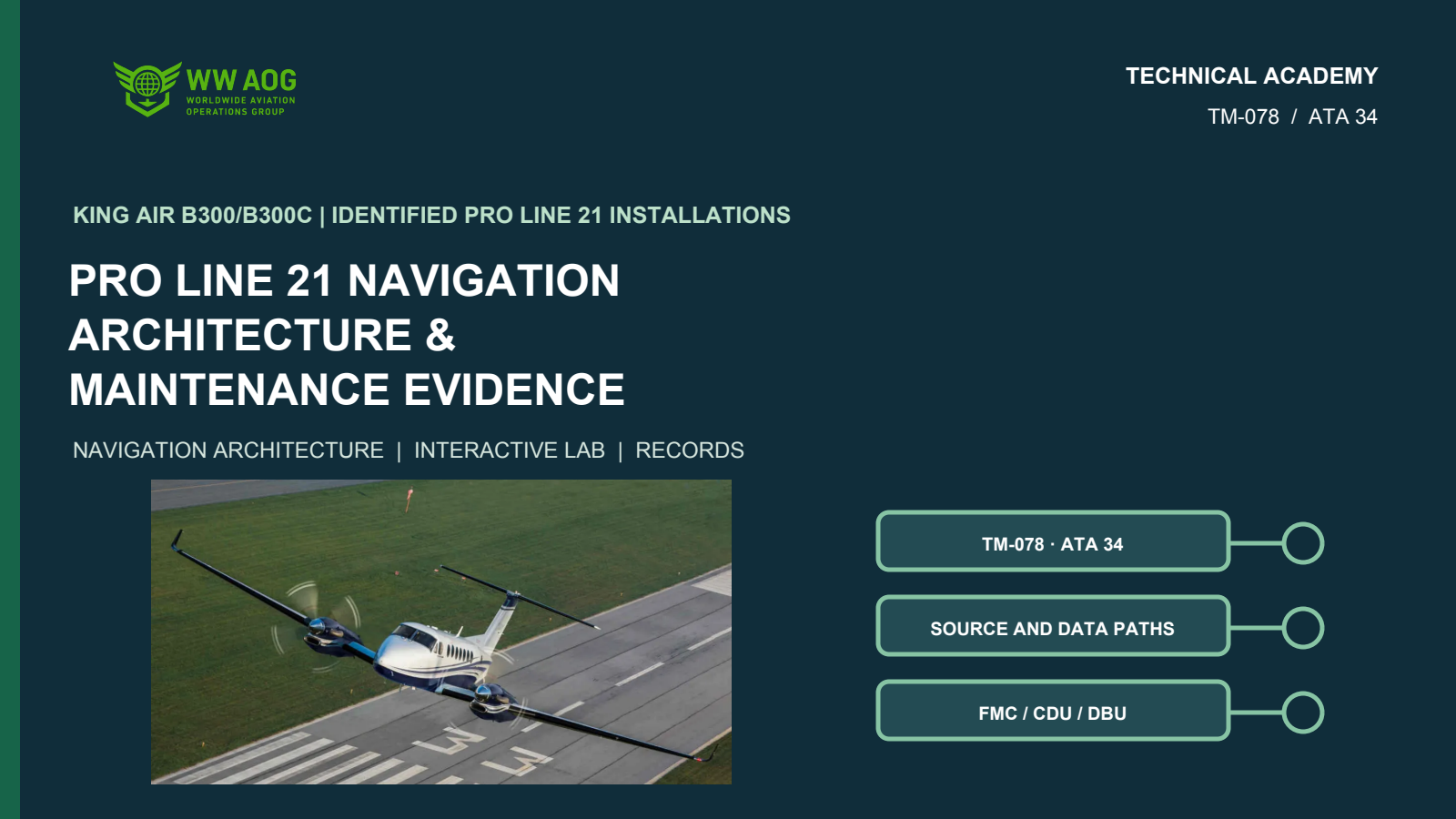
Navigation architecture and maintenance-evidence study for the identified B300/B300C Pro Line 21 NAV, DME, GPS, FMC/CDU and DBU installations in supplied Textron 130-590031-11 Chapter 34. Receiver availability, selected use, position references and named loading observations are kept separate. Source task dates and installed equipment control applicability. Detailed supplier RF/LRU test methods, performance certification and authorization for actual maintenance are outside this course. Based on the identified supplied Textron 130-590031-11 Chapter 34 pages, with individual task dates and applicability preserved in the handbook. General navigation purposes are supported by FAA-H-8083-31B (2023). Online completion and observed practical qualification remain separate.
WWAOG provides independent training. Online completion records knowledge and simulation achievement; it does not replace observed practical qualification, employer authorization or applicable licensing. Use current aircraft-effective maintenance instructions for physical work.