WW AOG — Worldwide Aviation Operations GroupView course & enroll ↗
KA200-071 · King Air 200/B200

King Air 200/B200 Powerplant Installation, Induction and Airframe Interface Diagnostics

Locate actual engine-to-firewall connections, cowling air paths, vibration mounts, latch hardware and early liquid-fuel collector versus later stored-air purge systems. A 34-page handbook and six original visual workshops support ten lesson decisions, ten paired cases and three independent six-field jobs. Includes a separate 40-question final at 80%.

Self-paced onlineWWAOG Technical Academy
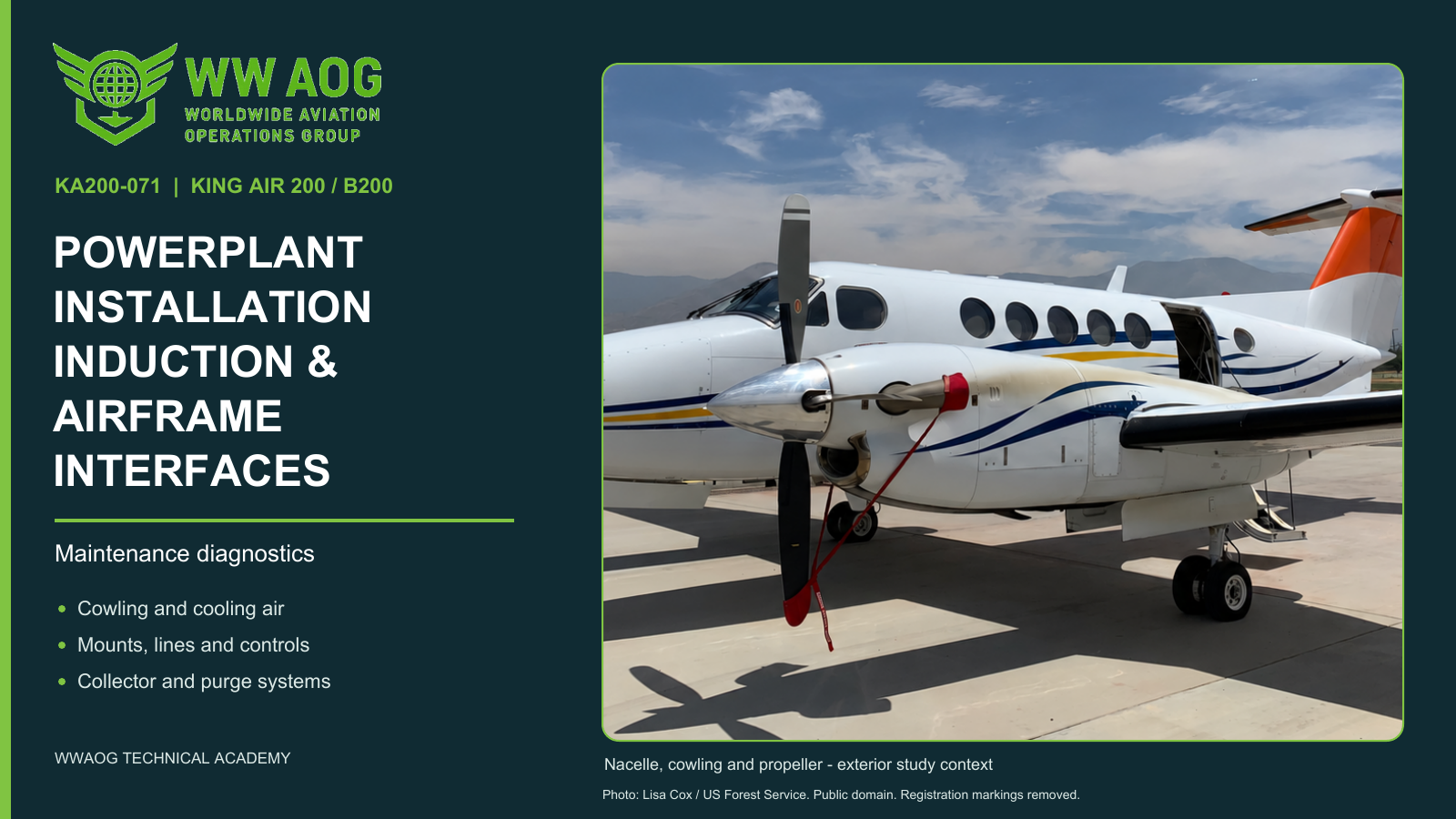
King Air 200/B200 Powerplant Installation, Induction and Airframe Interface Diagnostics course cover

Photo: Lisa Cox / US Forest Service. King Air 200 nacelle, cowling and propeller exterior context; the photograph does not identify a specific installed-engine profile. View photograph source · Public domain (U.S. federal work). Registration markings and agency/manufacturer lettering removed with the approved image edit; cropped for this cover.

Inside KA200-071

What you will study

Installed package and cowling air paths

Separate the free turbine and accessory gearbox, then locate four cowling assemblies, inlet/vane/hot-lip connections, cooling outlets and actual tagged QEC interfaces.

Mount joints, alignment and latch hardware

Keep each torque band with its named engine-pad, isolator-center or firewall joint. Compare measured gaps, listed shim sums, thread projection, cowl fit and line clearance. Distinguish indexed cams from threaded clevises.

Two different fuel-drain installations

Trace early liquid fuel from the collector through an electric pump/filter toward the nacelle tank. Compare the later compressor-P3 charging and shutdown air-purge paths, then interpret distinct valve, drying and flow-divider tests.

Complete measured maintenance records

Use actual starting conditions, named observations, repeated results and required restoration. A running pump, in-band torque or clean-looking cowl does not establish every other affected function.

Learning outcomes

  • Identify the actual engine, QEC inventory and airframe interfaces.
  • Trace cowling inlet, cooling and separator connections by their named component.
  • Compare each fastener, gap, shim and clearance with the actual task measurement.
  • Distinguish early collector delivery from later P3 stored-air purge.
  • Interpret operating state, repeat observations and complete affected restoration.

Aircraft and course applicability

Airframe powerplant installation and maintenance-record study for PT6A-41 Model 200 and PT6A-42 B200 using supplied Maintenance Manual 101-590010-19 Chapter 71, effective-page list November 1, 2024, with mixed task dates. Chapter 72 identifies the separate detailed engine-maintenance authority. Actual serial, mount/cowl/accessory configuration and early collector or later P3 purge branch select the task. Detailed engine-internal repair, full engine-control rigging, exhaust damage limits and unseen wiring pinouts are outside this course. Physical work uses complete current applicable instructions, required equipment and qualified personnel.

WWAOG provides independent training. Online completion records knowledge and simulation achievement; it does not replace observed practical qualification, employer authorization or applicable licensing. Use current aircraft-effective maintenance instructions for physical work.
Before you enroll

Is this course suitable for my aircraft or role?

Airframe powerplant installation and maintenance-record study for PT6A-41 Model 200 and PT6A-42 B200 using supplied Maintenance Manual 101-590010-19 Chapter 71, effective-page list November 1, 2024, with mixed task dates. Chapter 72 identifies the separate detailed engine-maintenance authority. Actual serial, mount/cowl/accessory configuration and early collector or later P3 purge branch select the task. Detailed engine-internal repair, full engine-control rigging, exhaust damage limits and unseen wiring pinouts are outside this course. Physical work uses complete current applicable instructions, required equipment and qualified personnel. If you are choosing training for a different installation or a team, email info@wwaog.com with your aircraft configuration, learner experience and training goals.

Where do I find the price and sign up?

Open the KA200-071 enrollment page for the current price, course contents and signup options. Enrollment takes place in WWAOG Academy, where learners access their assigned content.

Can WWAOG train our team at our location?

Yes. Tailored on-site training is available by separate arrangement. Describe your aircraft, location, team size and learning objectives so WWAOG can propose an appropriate scope.

Free course sample · KA200-071

Learn the relationship. Test your reasoning.

Try a short teaching exercise from the subject of King Air 200/B200 Powerplant Installation, Induction and Airframe Interface Diagnostics. No account needed.

About 2 minutes
01 · Understand

In the identified early King Air 200 collector installation, flow-divider dump fuel enters a collector below the accessory area. A float commands the electric pump under the specified power condition. The pump/filter returns collected fuel through a protected line toward the nacelle tank. Motor operation and actual fuel return are separate observations.

Trace control, motor operation and liquid delivery separately
  1. Collector contains liquid fuel; float raised
  2. Qualified feed and ground; pump motor running
  3. No measured fuel return at the identified outlet
02 · Read the supplied record

Original measured training record: Model 200 BB-600 with the installed early liquid-fuel collector. The prescribed operational-test setup is confirmed. Liquid fuel is present, the raised float commands the pump, motor feed/polarity/ground are qualified and the motor operates. No return is measured at the identified outlet.

03 · Make a decisionWhich next inspection best addresses the missing fuel return while the collector pump is running?

Original public teaching example based on the course’s published scope. Supplied records and values are training data. Aircraft maintenance uses current applicable instructions; this sample does not record course completion.

Explore more free course samplesReview KA200-071 and enroll ↗

Regional standards and support

Our aircraft systems courses use manufacturer technical manuals to support pilots and maintenance personnel working in FAA- and EASA-regulated aviation. Training combines detailed system explanations, knowledge checks and interactive exercises for initial familiarization and recurrent study.

Training at your location

Your aircraft. Your team. A course built around both.

WWAOG offers tailored on-site courses for operators, maintenance organizations and government teams. We can shape the course around your aircraft configuration, installed systems, technician experience and operational training goals.

Tell us what your team needs

  • Aircraft model and equipment configuration
  • Location, group size and technician experience
  • System topics and desired learning outcomes
  • Preferred dates and available training resources

We’ll agree the scope, delivery plan and quotation before scheduling. Tailored on-site training is arranged separately from individual online course enrollment.

Request tailored on-site training
KA200-071 · Self-paced learning

Build knowledge you can apply to better maintenance decisions.