WW AOG — Worldwide Aviation Operations GroupView course & enroll ↗
KA200-077 · King Air 200/B200

King Air 200/B200 Engine Indication and Calibration Diagnostics

Trace actual N1/N2 generators, torque and oil-pressure transmitters, ITT thermocouples, fuel-flow methods and Pro Line 21 DCU/EDC display paths. A 34-page handbook and six interactive visual workbenches support ten lesson decisions, ten paired cases and three independent five-field jobs. Includes a separate 40-question final at 80%.

Self-paced onlineWWAOG Technical Academy
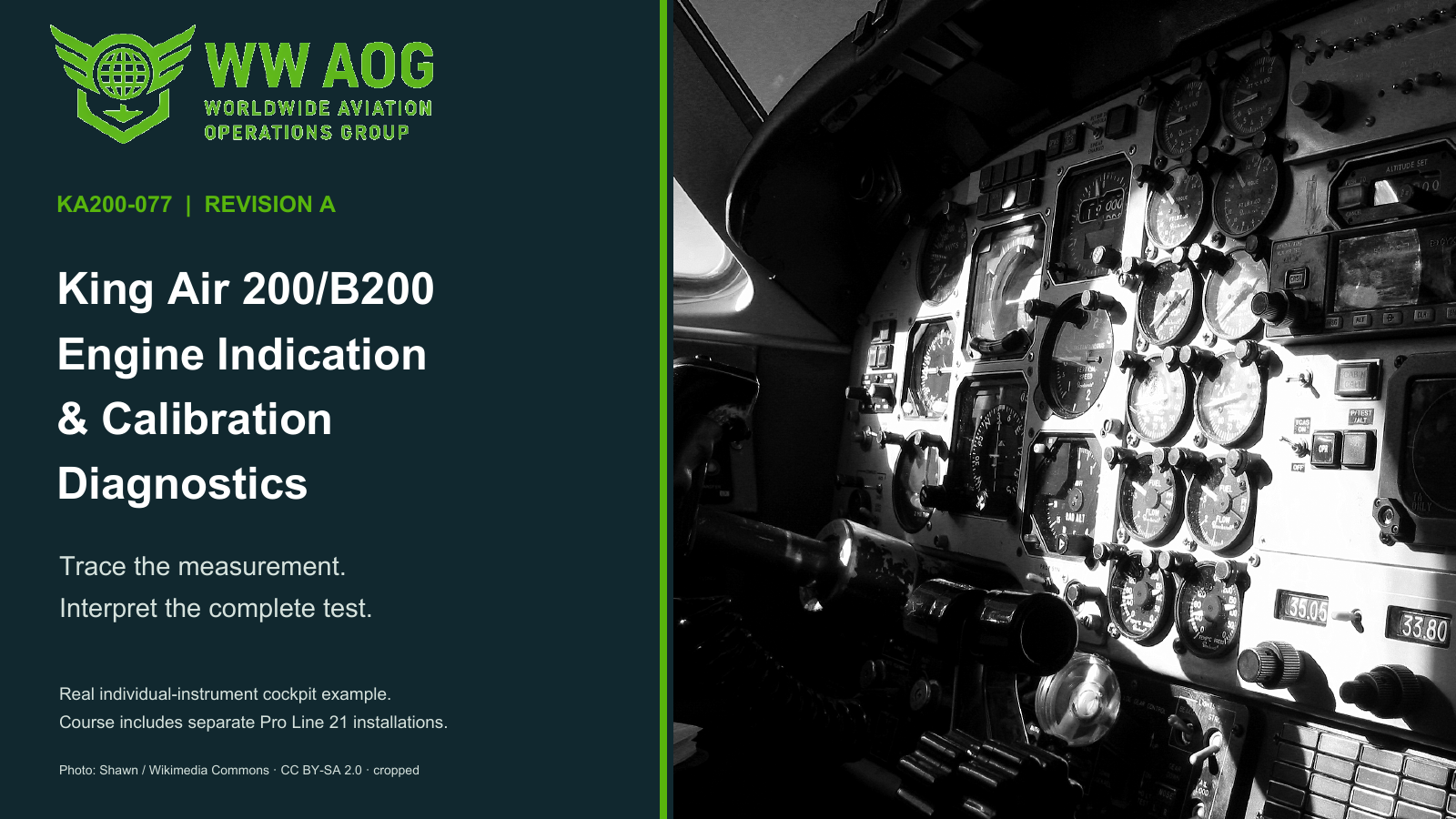
King Air 200/B200 Engine Indication and Calibration Diagnostics course cover

Photo: Shawn. Real individual-instrument King Air 200 cockpit; the Pro Line 21 installation is taught separately. View photograph source · CC BY-SA 2.0. Cropped for this cover; no instrument geometry altered. The registration placard is outside the crop.

Inside KA200-077

What you will study

Actual measurement and test boundaries

Locate N1 and N2 gearbox drives, torque manifold/transmitter, T5 junction, MT5 and oil sensors. Distinguish an actual sensor test from an injected electrical indication check.

Task-specific calibration and measured comparison

Compare pressure, voltage, resistance, temperature and frequency with the exact installed task band. Keep analog, Meggitt and Pro Line 21 methods distinct.

ITT and fuel-flow reasoning

Separate engine-loop resistance, insulation, early airframe harness and injected temperature. Compare proportional slope, constant offset and later no-adjustment fuel-flow branches.

Concentrator and display reversion

Follow normal DCU and secondary EDC paths, timed comparator observations and Pilot Display NORM/PFD presentation separately. Build a repeatable performance and restoration record.

Learning outcomes

  • Select the correct instrument, concentrator and engine-model task branch.
  • Trace each actual sensor signal and identify what an injected test excludes.
  • Calculate task-specific measured deviations and classify each boundary.
  • Distinguish DCU/EDC reversion from MFD/PFD display selection.
  • Record comparable performance conditions, repeat results and complete restoration.

Aircraft and course applicability

Systems and measured maintenance-record training for PT6A-41 Model 200 and PT6A-42 B200 engine indication branches in Maintenance Manual 101-590010-19 Chapter 77, supplied LEP November 1, 2024. Individual analog/Regan/Meggitt and Pro Line 21 tasks retain their own serial, equipment and test conditions. B200GT/PT6A-52 performance procedures are outside these examples. Physical maintenance uses complete current applicable instructions and qualified personnel.

WWAOG provides independent training. Online completion records knowledge and simulation achievement; it does not replace observed practical qualification, employer authorization or applicable licensing. Use current aircraft-effective maintenance instructions for physical work.
Before you enroll

Is this course suitable for my aircraft or role?

Systems and measured maintenance-record training for PT6A-41 Model 200 and PT6A-42 B200 engine indication branches in Maintenance Manual 101-590010-19 Chapter 77, supplied LEP November 1, 2024. Individual analog/Regan/Meggitt and Pro Line 21 tasks retain their own serial, equipment and test conditions. B200GT/PT6A-52 performance procedures are outside these examples. Physical maintenance uses complete current applicable instructions and qualified personnel. If you are choosing training for a different installation or a team, email info@wwaog.com with your aircraft configuration, learner experience and training goals.

Where do I find the price and sign up?

Open the KA200-077 enrollment page for the current price, course contents and signup options. Enrollment takes place in WWAOG Academy, where learners access their assigned content.

Can WWAOG train our team at our location?

Yes. Tailored on-site training is available by separate arrangement. Describe your aircraft, location, team size and learning objectives so WWAOG can propose an appropriate scope.

Free course sample · KA200-077

Learn the relationship. Test your reasoning.

Try a short teaching exercise from the subject of King Air 200/B200 Engine Indication and Calibration Diagnostics. No account needed.

About 2 minutes
01 · Understand

In the specified Pro Line 21 oil-pressure check, calibrated pressure-test equipment applies 100 psi to the MT2 oil-pressure transmitter. The technician measures its voltage and reads the oil-pressure indication on the multifunction display (MFD). The supplied task criteria are 2.50 ±0.10 V at MT2 and 100 ±4 psi on the MFD. A correct transmitter voltage can coexist with an incorrect displayed pressure.

Follow pressure to voltage, then voltage to displayed pressure
  1. Qualified pressure source: 100 psi
  2. MT2 output: 2.50 V
  3. MFD oil pressure: 109 psi
02 · Read the supplied record

Original supplied training record: B200 Pro Line 21, applicable oil-pressure task. Applied 100 psi and transmitter supply/return are qualified. MT2 output is 2.50 V, but the MFD shows 109 psi. Connections and measuring equipment follow the selected task.

03 · Make a decisionMT2 output voltage is correct but the MFD oil-pressure indication is high. Which part of the indication system should the technician investigate next?

Original public teaching example based on the course’s published scope. Supplied records and values are training data. Aircraft maintenance uses current applicable instructions; this sample does not record course completion.

Explore more free course samplesReview KA200-077 and enroll ↗

Regional standards and support

Our aircraft systems courses use manufacturer technical manuals to support pilots and maintenance personnel working in FAA- and EASA-regulated aviation. Training combines detailed system explanations, knowledge checks and interactive exercises for initial familiarization and recurrent study.

Training at your location

Your aircraft. Your team. A course built around both.

WWAOG offers tailored on-site courses for operators, maintenance organizations and government teams. We can shape the course around your aircraft configuration, installed systems, technician experience and operational training goals.

Tell us what your team needs

  • Aircraft model and equipment configuration
  • Location, group size and technician experience
  • System topics and desired learning outcomes
  • Preferred dates and available training resources

We’ll agree the scope, delivery plan and quotation before scheduling. Tailored on-site training is arranged separately from individual online course enrollment.

Request tailored on-site training
KA200-077 · Self-paced learning

Build knowledge you can apply to better maintenance decisions.