WW AOG — Worldwide Aviation Operations GroupView course & enroll ↗
TP-100 · General maintenance

Aircraft Technical Publications, Wiring Diagrams & Parts Identification

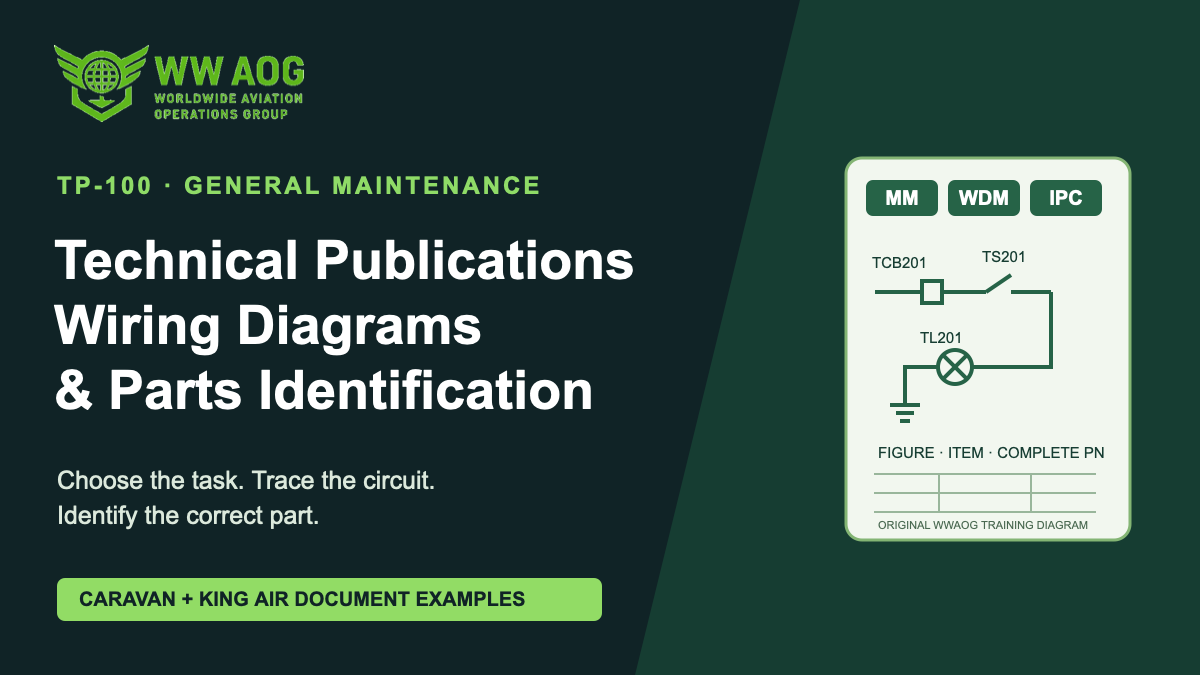
Read the applicable maintenance task, trace named circuits and identify complete parts rows. A 31-page illustrated handbook, nine lesson decisions, ten two-part practice cases and three document work orders connect aircraft effectivity, wiring sheets, connector views and IPC parts requests. Includes a separate 40-question final at 80%.

Self-paced onlineWWAOG Technical Academy
Aircraft Technical Publications, Wiring Diagrams & Parts Identification course cover
Inside TP-100

What you will study

Choose the right document and aircraft branch

Distinguish the maintenance manual, WDM, IPC, SRM, CMM and installation ICA. Check revision, effective pages, temporary revisions, aircraft serial number and modification status. Follow the printed task address and cross-reference rather than relying on a PDF page number alone.

Trace the circuit and read the connector view

Follow the training reading-light circuit through its circuit breaker, switch, splice, connector, lamp and ground. Keep aircraft zones separate from drawing grids. Identify the connector, key and printed viewing direction before interpreting cavity positions; compare voltage on both lamp terminals and across the connected lamp.

Turn the IPC figure item into a complete parts request

Relate figure and item number to part number, nomenclature, usable-on code and quantity per parent assembly. Interpret indented parts rows, AR and RF entries and replacement notes without treating a balloon, similar description or later-looking number as a complete applicability decision.

Complete three document work orders

Use fresh configuration, circuit and parts records to select the applicable instruction, enter a measured result and identify the full part and parent quantity. Explanations show what supports each decision and what still needs to be checked. All work-order fields must be mastered before the lab can pass.

Learning outcomes

  • Identify the applicable publication, revision, aircraft serial and modification branch.
  • Follow task references, wiring continuations and location references without mixing their numbering systems.
  • Read a named connector view and interpret connected-load voltage measurements.
  • Build a parts request from the complete IPC row, usable-on code and parent quantity.
  • Document the instruction, configuration, measurements and restoration evidence needed for a traceable handoff.

Aircraft and course applicability

Cross-aircraft document-reading training using identified examples from supplied Caravan MM D2078 Revision 42, WDM D2079-13 Revision A4, IPC P688-12 Revision A4 and King Air 200-series MM 101-590010-19 Chapter 76. These study editions illustrate the stated publication conventions; they do not establish current applicability for an aircraft. Original TP-/TRN- circuit drawings, connector tables, parts and work records are fictional training data. King Air wiring-diagram and IPC conventions are not inferred from Caravan documents. Physical aircraft work requires the current applicable controlled instructions and aircraft configuration.

WWAOG provides independent training. Online completion records knowledge and simulation achievement; it does not replace observed practical qualification, employer authorization or applicable licensing. Use current aircraft-effective maintenance instructions for physical work.
Before you enroll

Is this course suitable for my aircraft or role?

Cross-aircraft document-reading training using identified examples from supplied Caravan MM D2078 Revision 42, WDM D2079-13 Revision A4, IPC P688-12 Revision A4 and King Air 200-series MM 101-590010-19 Chapter 76. These study editions illustrate the stated publication conventions; they do not establish current applicability for an aircraft. Original TP-/TRN- circuit drawings, connector tables, parts and work records are fictional training data. King Air wiring-diagram and IPC conventions are not inferred from Caravan documents. Physical aircraft work requires the current applicable controlled instructions and aircraft configuration. If you are choosing training for a different installation or a team, email info@wwaog.com with your aircraft configuration, learner experience and training goals.

Where do I find the price and sign up?

Open the TP-100 enrollment page for the current price, course contents and signup options. Enrollment takes place in WWAOG Academy, where learners access their assigned content.

Can WWAOG train our team at our location?

Yes. Tailored on-site training is available by separate arrangement. Describe your aircraft, location, team size and learning objectives so WWAOG can propose an appropriate scope.

Free course sample · TP-100

Learn the relationship. Test your reasoning.

Try a short teaching exercise from the subject of Aircraft Technical Publications, Wiring Diagrams & Parts Identification. No account needed.

About 2 minutes
01 · Understand

A lamp needs a complete path from electrical supply through the lamp and back to ground. A voltage reading on its feed wire alone does not show the voltage across the connected lamp. Read both lamp terminals against the same ground, then compare the difference and the named return path on the wiring diagram.

Original fictional reading-light training circuit
  1. CB201 circuit breaker and S201 switch
  2. L201 connected reading lamp
  3. L201 return wire to G201 ground
02 · Read the supplied record

In this fictional TP-100 circuit, CB201 and S201 feed reading lamp L201, whose separate return wire connects to ground G201. With S201 ON and L201 connected, the lamp remains dark. Relative to G201, the feed terminal measures +27.9 V and the return terminal +27.7 V; the voltage measured directly across L201 is 0.2 V. The supply at CB201 is +28.0 V.

03 · Make a decisionWhich circuit path should be investigated first to explain these L201 terminal readings?

Original public teaching example based on the course’s published scope. Supplied records and values are training data. Aircraft maintenance uses current applicable instructions; this sample does not record course completion.

Explore more free course samplesReview TP-100 and enroll ↗

Regional standards and support

Our aircraft systems courses use manufacturer technical manuals to support pilots and maintenance personnel working in FAA- and EASA-regulated aviation. Training combines detailed system explanations, knowledge checks and interactive exercises for initial familiarization and recurrent study.

Training at your location

Your aircraft. Your team. A course built around both.

WWAOG offers tailored on-site courses for operators, maintenance organizations and government teams. We can shape the course around your aircraft configuration, installed systems, technician experience and operational training goals.

Tell us what your team needs

  • Aircraft model and equipment configuration
  • Location, group size and technician experience
  • System topics and desired learning outcomes
  • Preferred dates and available training resources

We’ll agree the scope, delivery plan and quotation before scheduling. Tailored on-site training is arranged separately from individual online course enrollment.

Request tailored on-site training
TP-100 · Self-paced learning

Build knowledge you can apply to better maintenance decisions.