WW AOG — Worldwide Aviation Operations GroupView course & enroll ↗
KA200-051 · King Air 200/B200

King Air 200/B200 Structural Inspection, Corrosion and Damage Assessment

Locate pressure-vessel members, aft-stringer joints and moisture paths. Compare bonded-panel tap evidence, assess named dent criteria and calculate directional control-surface balance. Includes four original visual workshops with 19 named controls, a 45-page handbook, ten lesson decisions, ten paired cases, three independent five-field jobs and a separate 40-question final at 80%.

Self-paced onlineWWAOG Technical Academy
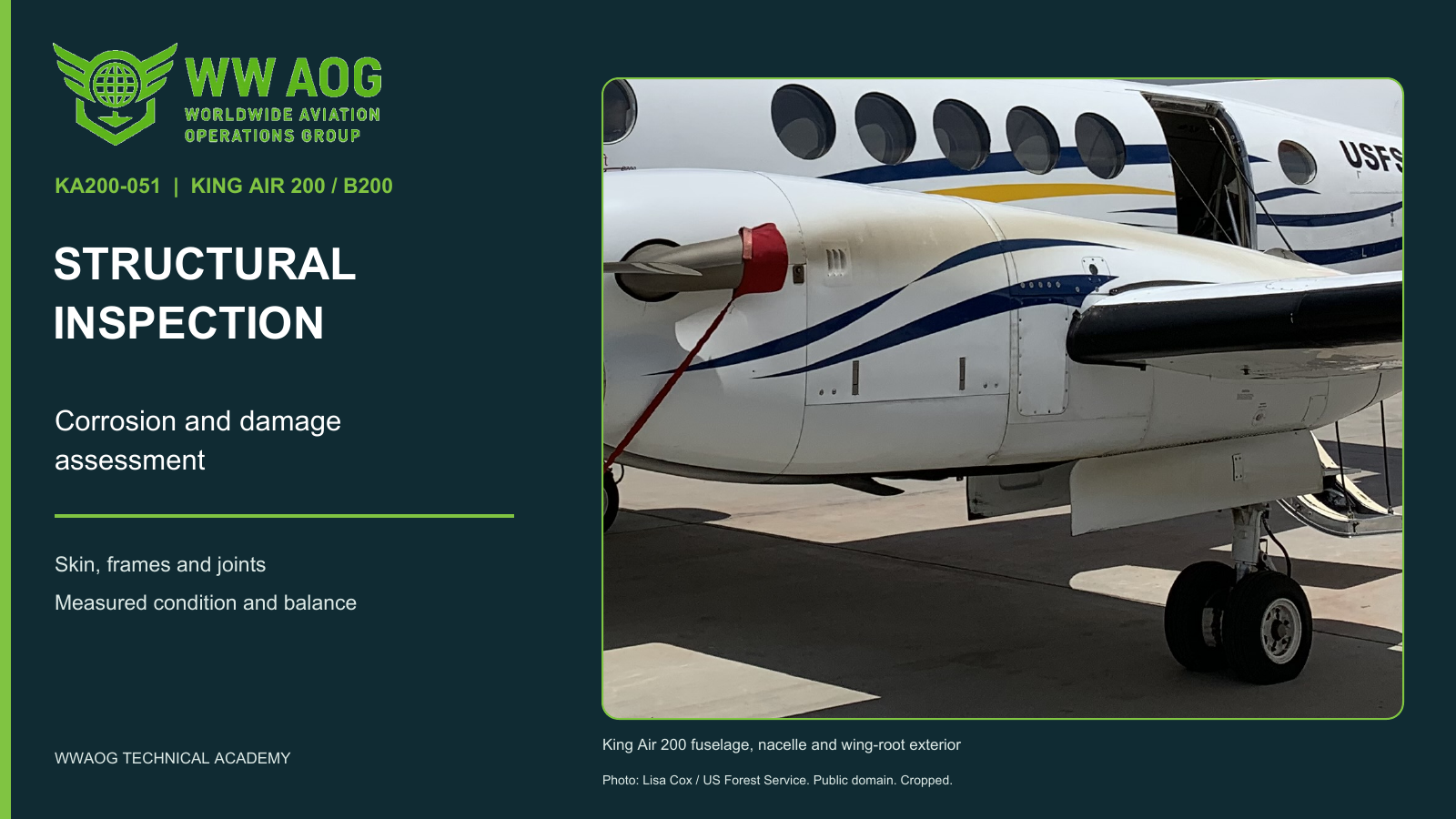
King Air 200/B200 Structural Inspection, Corrosion and Damage Assessment course cover

Photo: Lisa Cox / US Forest Service. King Air 200 fuselage, nacelle and wing-root exterior. View photograph source · Public domain (U.S. federal work). Cropped from the original photograph; hardware unchanged. Registration markings are outside the visible crop.

Inside KA200-051

What you will study

Find the actual member

Follow skin, frames, stringers and bulkheads; locate FS 84.00/347.75 boundaries and the six-rivet flat-web/zee-stiffener connection. Keep partial rework and side-specific kit identity explicit.

Interpret the measured damage

Compare controlled bonded-panel reference zones with a known competing drain-tube response. Evaluate depth, affected area and required spacing under the actual material/access branch.

Preserve the joint configuration

Distinguish early tension and later lower-forward shear joints, upper soft aluminum washers and installed spar-bridge expansion/clamp-up hardware.

Verify post-repair restoration

Use directional elevator, rudder and aircraft-specific aileron moment bands; distinguish stabilizer fit, installation torque, nonrotation checks and control restoration.

Learning outcomes

  • Locate the pressure vessel and distinguish primary load-carrying structure from secondary fairings.
  • Plan an inspection around actual floorline, bulkhead, opening and attachment locations.
  • Locate the six-rivet flat-web inspection area and use side, stringer number and actual repair status.
  • Locate the aft drainage paths and preserve protection at wing joints and fuel-bay interfaces.
  • Use known reference zones and distinguish a suspected separation from a drain-tube sound change.
  • Apply depth, affected area and spacing criteria to named secondary skins and keep the wing-upper exception separate.
  • Read the actual joint configuration and keep tension, shear and expansion-bolt records separate.
  • Calculate balance moment with explicit nose/tail direction, correct tare and the actual surface/model range.
  • Interpret the actual horizontal/vertical stabilizer gap and fastener checks without mixing their joints.
  • Connect each disturbed structural boundary to its measured recheck and required restoration.

Aircraft and course applicability

Original training based on supplied 101-590010-19 Chapters 51, 53, 55 and 57. Includes named structural inspections, moisture paths, bounded secondary-skin damage measurements, wing-joint configuration and post-repair control-surface balance. Model, serial, repair and kit branches remain explicit. It does not provide new repair design, strength substantiation, a complete SIRM/airworthiness-limitation inspection program, specialized absorber tuning or aircraft release authority. Chapter LEPs: 51/55 January 1, 2019; 53/57 November 1, 2024; individual task dates vary. Current online currency has not been verified.

WWAOG provides independent training. Online completion records knowledge and simulation achievement; it does not replace observed practical qualification, employer authorization or applicable licensing. Use current aircraft-effective maintenance instructions for physical work.
Before you enroll

Is this course suitable for my aircraft or role?

Original training based on supplied 101-590010-19 Chapters 51, 53, 55 and 57. Includes named structural inspections, moisture paths, bounded secondary-skin damage measurements, wing-joint configuration and post-repair control-surface balance. Model, serial, repair and kit branches remain explicit. It does not provide new repair design, strength substantiation, a complete SIRM/airworthiness-limitation inspection program, specialized absorber tuning or aircraft release authority. Chapter LEPs: 51/55 January 1, 2019; 53/57 November 1, 2024; individual task dates vary. Current online currency has not been verified. If you are choosing training for a different installation or a team, email info@wwaog.com with your aircraft configuration, learner experience and training goals.

Where do I find the price and sign up?

Open the KA200-051 enrollment page for the current price, course contents and signup options. Enrollment takes place in WWAOG Academy, where learners access their assigned content.

Can WWAOG train our team at our location?

Yes. Tailored on-site training is available by separate arrangement. Describe your aircraft, location, team size and learning objectives so WWAOG can propose an appropriate scope.

Free course sample · KA200-051

Learn the relationship. Test your reasoning.

Try a short teaching exercise from the subject of King Air 200/B200 Structural Inspection, Corrosion and Damage Assessment. No account needed.

About 2 minutes
01 · Understand

A dent assessment names the actual panel, material and accessible faces before comparing depth, affected area and required separation. A maximum depth and minimum distance are different comparisons; one passing value cannot compensate for another failed condition.

Keep depth, area and spacing as separate measured conditions
  1. Secondary aluminum skin; both sides accessible.
  2. Depth ≤0.100 in.; area ≤10% of one ft² (14.4 in²).
  3. Nearest rivet/structural separation ≥0.50 in.; no sharp crease or penetration.
02 · Read the supplied record

Original supplied B200 record: an identified secondary aluminum fairing accessible from both sides has a smooth dent 0.093 inch deep. Its affected area within one square foot is 13.2 in²; the nearest rivet is 0.46 inch from the dent. There is no sharp crease or penetration. The pressure-vessel skin and isolated wing-upper exception are not the selected task.

03 · Make a decisionWhich record correctly classifies the three supplied geometric comparisons?

Original public teaching example based on the course’s published scope. Supplied records and values are training data. Aircraft maintenance uses current applicable instructions; this sample does not record course completion.

Explore more free course samplesReview KA200-051 and enroll ↗

Regional standards and support

Our aircraft systems courses use manufacturer technical manuals to support pilots and maintenance personnel working in FAA- and EASA-regulated aviation. Training combines detailed system explanations, knowledge checks and interactive exercises for initial familiarization and recurrent study.

Training at your location

Your aircraft. Your team. A course built around both.

WWAOG offers tailored on-site courses for operators, maintenance organizations and government teams. We can shape the course around your aircraft configuration, installed systems, technician experience and operational training goals.

Tell us what your team needs

  • Aircraft model and equipment configuration
  • Location, group size and technician experience
  • System topics and desired learning outcomes
  • Preferred dates and available training resources

We’ll agree the scope, delivery plan and quotation before scheduling. Tailored on-site training is arranged separately from individual online course enrollment.

Request tailored on-site training
KA200-051 · Self-paced learning

Build knowledge you can apply to better maintenance decisions.