WW AOG — Worldwide Aviation Operations GroupView course & enroll ↗
KA200-028 · King Air 200/B200

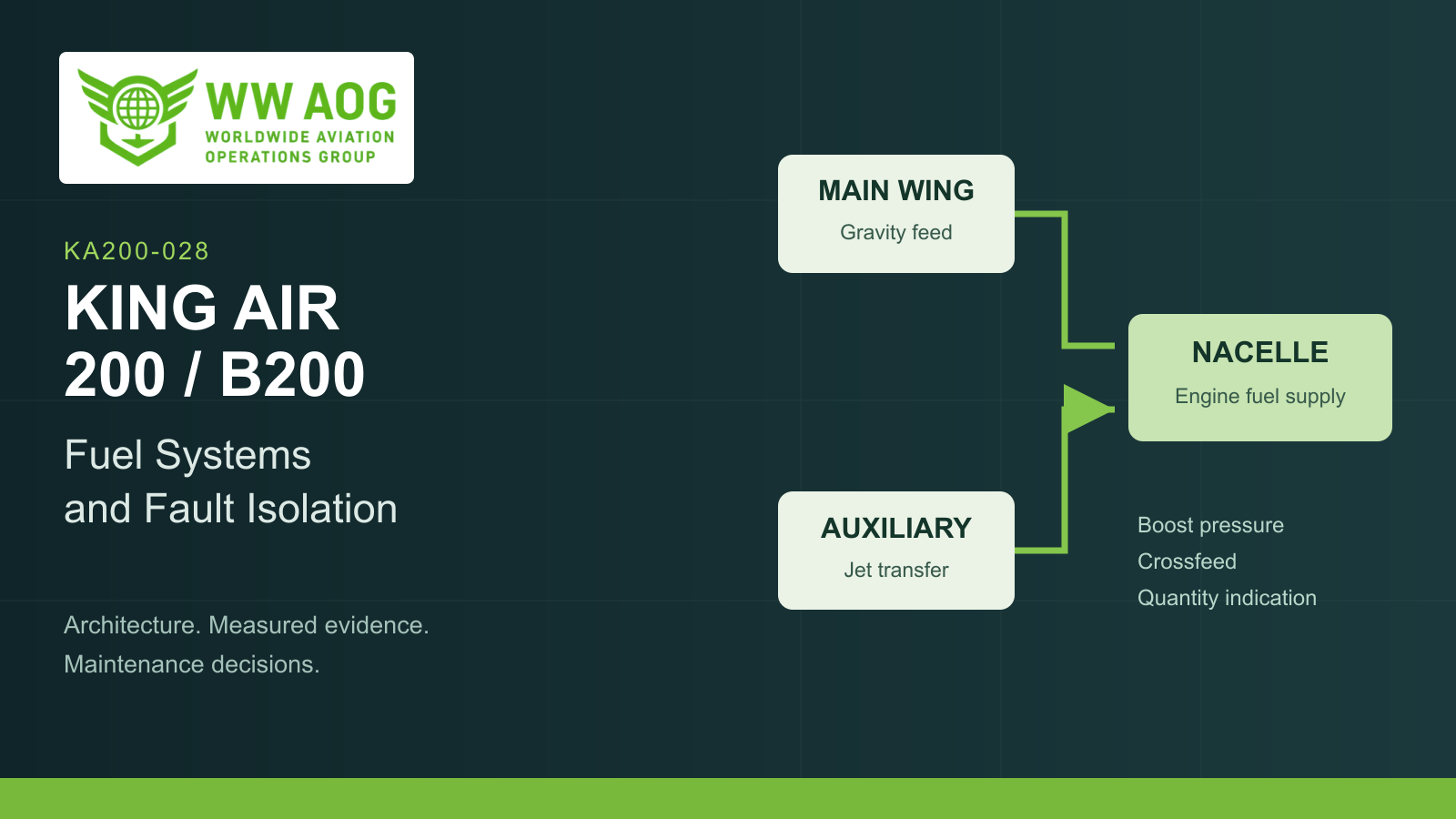
King Air 200/B200 Fuel Systems and Fault Isolation

Trace main-wing gravity feed, auxiliary jet-pump transfer, standby boost and crossfeed using the actual King Air 200/B200 component names. A 35-page handbook, interactive fuel schematic, ten two-part fault cases and three measured work records connect system operation to a defensible diagnosis. Includes a separate 40-question final at 80%.

Self-paced onlineWWAOG Technical Academy
King Air 200/B200 Fuel Systems and Fault Isolation course cover
Inside KA200-028

What you will study

Trace main-wing and auxiliary fuel to the nacelle

Follow the actual gravity-feed network and distinguish it from motive-fuel-powered auxiliary jet transfer. Separate the nacelle reservoir, auxiliary center-section cell, motive-flow valve and jet transfer pump.

Distinguish engine feed, standby power and crossfeed

Trace the firewall shutoff, engine-driven boost pump, firewall filter, fuel-flow transmitter, heater and engine fuel pump/FCU. Explain the standby hot feed and identify which tank supplies the opposite engine through crossfeed.

Read quantity and pressure findings correctly

Keep FUEL PRESSURE, NO TRANSFER and FUEL CROSSFEED separate. Interpret MAIN/AUX probe selection, individual-probe capacitance, insulation conductance and a controlled P281 connector comparison.

Complete measured and independent jobs

Use ten lesson decisions, ten two-part coached cases and three five-field work records to connect the configuration, complaint, observations, next isolation and required restoration. All lab groups are required before passing; the final contains 40 questions at 80%.

Learning outcomes

  • Select the correct schematic using aircraft serial number and S.I. 1021 status.
  • Explain main gravity feed, auxiliary transfer and the normal nacelle-to-engine component path.
  • Distinguish standby-pump power and crossfeed donor pressure from tank-to-tank transfer.
  • Interpret named pressure, quantity, capacitance and insulation findings in their stated test conditions.
  • Use a controlled comparison to identify the next isolation task and retain restoration requirements.

Aircraft and course applicability

King Air 200/B200 maintenance-system training using the supplied Model 200-series Maintenance Manual 101-590010-19 Chapter 28, whose list of effective pages is dated November 1, 2024. Individual task dates, aircraft serial numbers and S.I. 1021 status identify each branch. The course does not transfer B300/B300C limits to the 200 series. Original teaching scenarios and measured records support diagnosis practice; the qualitative schematic does not simulate hydraulic rates or automatic command timing. Physical aircraft work requires current applicable controlled instructions and the installed configuration.

WWAOG provides independent training. Online completion records knowledge and simulation achievement; it does not replace observed practical qualification, employer authorization or applicable licensing. Use current aircraft-effective maintenance instructions for physical work.
Before you enroll

Is this course suitable for my aircraft or role?

King Air 200/B200 maintenance-system training using the supplied Model 200-series Maintenance Manual 101-590010-19 Chapter 28, whose list of effective pages is dated November 1, 2024. Individual task dates, aircraft serial numbers and S.I. 1021 status identify each branch. The course does not transfer B300/B300C limits to the 200 series. Original teaching scenarios and measured records support diagnosis practice; the qualitative schematic does not simulate hydraulic rates or automatic command timing. Physical aircraft work requires current applicable controlled instructions and the installed configuration. If you are choosing training for a different installation or a team, email info@wwaog.com with your aircraft configuration, learner experience and training goals.

Where do I find the price and sign up?

Open the KA200-028 enrollment page for the current price, course contents and signup options. Enrollment takes place in WWAOG Academy, where learners access their assigned content.

Can WWAOG train our team at our location?

Yes. Tailored on-site training is available by separate arrangement. Describe your aircraft, location, team size and learning objectives so WWAOG can propose an appropriate scope.

Free course sample · KA200-028

Learn the relationship. Test your reasoning.

Try a short teaching exercise from the subject of King Air 200/B200 Fuel Systems and Fault Isolation. No account needed.

About 2 minutes
01 · Understand

The auxiliary jet transfer pump has no electric drive motor. Boost fuel passes through the motive-flow valve to provide the energy for transfer into the nacelle. AUTO commands that valve through the automatic transfer module; AUX TRANSFER OVERRIDE supplies a direct command. Comparing those two modes can separate the automatic command path from the common valve and fuel path.

Original King Air 200/B200 auxiliary-transfer training example
  1. Automatic transfer module or direct OVERRIDE command
  2. Motive-flow valve and pressurized motive fuel
  3. Jet transfer pump moves auxiliary fuel into the nacelle
02 · Read the supplied record

In this fictional left-side maintenance record, the auxiliary tank contains fuel and normal boost pressure is confirmed. The prescribed initial automatic-transfer/start-protection delay has elapsed. In AUTO, auxiliary quantity does not decrease, nacelle quantity decreases and the motive-flow valve receives 0 V. In OVERRIDE, the valve receives 28 V, auxiliary quantity decreases and nacelle quantity recovers. The same valve, wiring downstream of the command connection and transfer plumbing are used for both comparisons.

03 · Make a decisionWhich next isolation best addresses the AUTO-only failure shown by these observations?

Original public teaching example based on the course’s published scope. Supplied records and values are training data. Aircraft maintenance uses current applicable instructions; this sample does not record course completion.

Explore more free course samplesReview KA200-028 and enroll ↗

Regional standards and support

Our aircraft systems courses use manufacturer technical manuals to support pilots and maintenance personnel working in FAA- and EASA-regulated aviation. Training combines detailed system explanations, knowledge checks and interactive exercises for initial familiarization and recurrent study.

Training at your location

Your aircraft. Your team. A course built around both.

WWAOG offers tailored on-site courses for operators, maintenance organizations and government teams. We can shape the course around your aircraft configuration, installed systems, technician experience and operational training goals.

Tell us what your team needs

  • Aircraft model and equipment configuration
  • Location, group size and technician experience
  • System topics and desired learning outcomes
  • Preferred dates and available training resources

We’ll agree the scope, delivery plan and quotation before scheduling. Tailored on-site training is arranged separately from individual online course enrollment.

Request tailored on-site training
KA200-028 · Self-paced learning

Build knowledge you can apply to better maintenance decisions.