What you will study
Read the drawing and identify the specified work
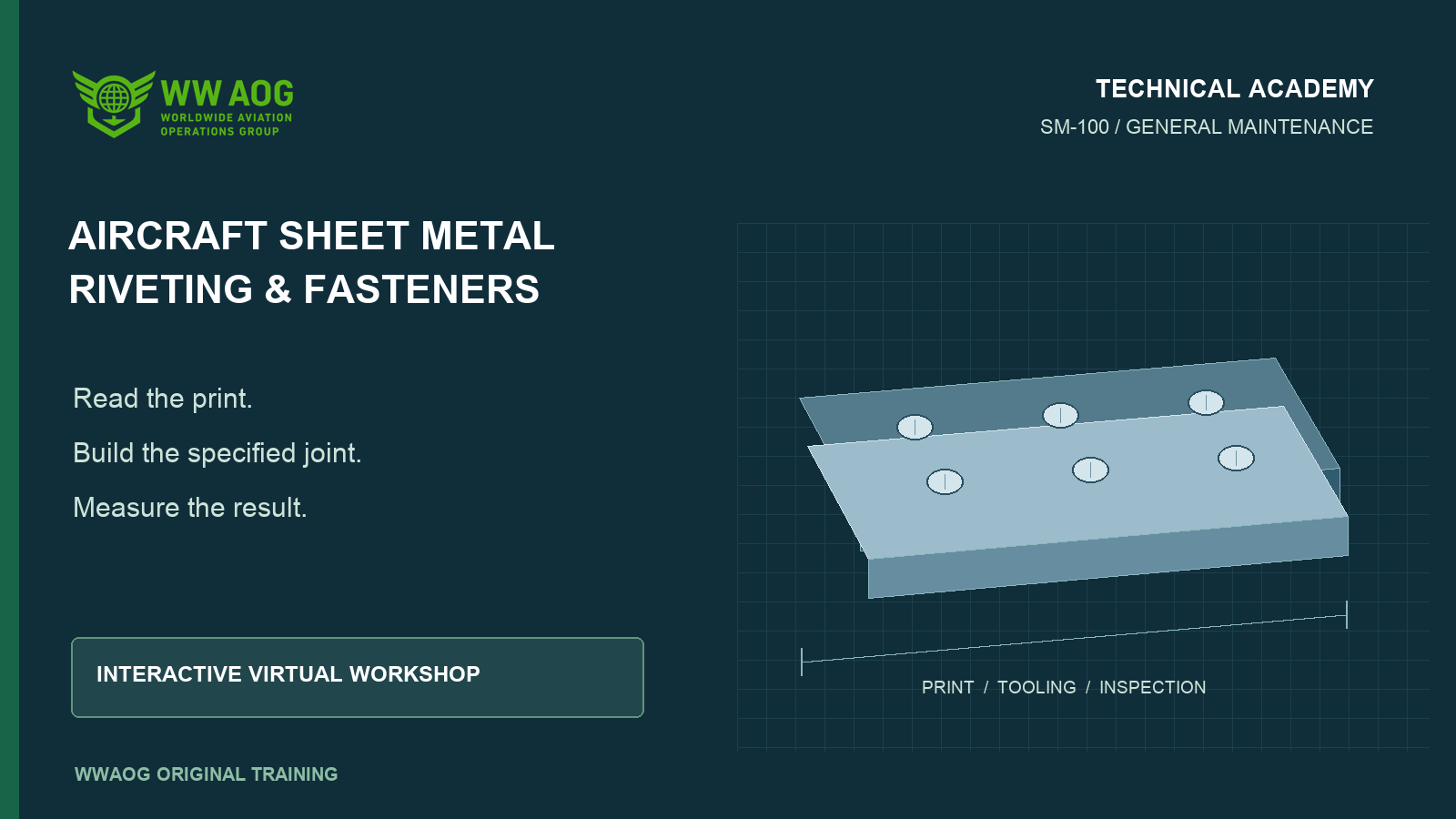
Connect drawing revisions, views, tolerances, notes and bill-of-materials item callouts. Use the original training print to identify the joint, parts and requirements before selecting a tool or fastener.
Lay out and prepare the riveted joint
Study drill-number and decimal sizes, edge distance, pitch and solid-rivet sizing. Keep nominal rivet diameter, drill markings and measured hole limits separate, and connect those distinctions with stack preparation and inspection.
Match fasteners and tooling to the requirement
Learn tool purposes, countersinking and dimpling. Compare the identified CherryLOCK and Hi-Lok family requirements for grip, holes and tooling within the course's stated training examples.
Inspect the joint and calculate the flat pattern
Work through seven virtual stations: release the drawing, lay out holes, prepare and inspect the stack, install the specified rivets, inspect the joint, set up flush-head details and calculate a flat pattern. Connect bend-allowance calculations with the original training print.
Demonstrate independent understanding
The published course includes ten lessons, a 53-page illustrated handbook, eight two-stage cases and twelve independent decisions. The twelve-question review requires at least ten correct answers and all eight critical decisions correct. Pass the separate forty-question final at 80% for the online completion certificate. Supervised hands-on skill development and authorization for actual aircraft work remain separate.
Learning outcomes
- Interpret drawing revisions, views, tolerances, notes and BOM callouts for an original training job.
- Distinguish nominal rivet diameter, drill markings and measured hole limits when evaluating a joint.
- Select the stated fastener-family, tooling and flush-head preparation requirements for a training example.
- Inspect a riveted training assembly and calculate the flat pattern using the supplied drawing requirements.
Aircraft and course applicability
General aircraft sheet-metal, riveting and fastener foundations using original training prints and a virtual workshop. Follow each training print's drawing revision, notes, bill of materials, tolerances and specified fastener family. Actual aircraft work requires current applicable drawings and instructions, supervised hands-on skill development and the required authorization. Online completion records knowledge and virtual-workshop achievement; practical qualification and maintenance authorization remain separate.
WWAOG provides independent training. Online completion records knowledge and simulation achievement; it does not replace observed practical qualification, employer authorization or applicable licensing. Use current aircraft-effective maintenance instructions for physical work.