What you will study
Separate gas energy from the two mechanical trains
Trace compressor, combustion and turbine flow while keeping the gas-generator mechanical train separate from the free-power/reduction-gearbox/propeller train. Relate N1 and N2 to their respective physical systems without using one speed observation to establish every other engine component.
Distinguish inertial separation from passive lip heating
Explain normal and ICE inlet airflow and the separate mechanisms that protect the inlet. Follow inertial vane geometry independently from the exhaust-gas route supplying the inlet lip. The passive heating path has its own scoop, supply, chamber and return interfaces; it is not modeled as a switched electric heater.
Trace motor capability, shared mechanics and position evidence
Compare the main and standby motor branches with the shared mechanical linkage. A second motor does not bypass a mechanical obstruction. Keep available movement capability, actual observed vane position, position sensing and the advisory path distinct. These supplied comparisons do not turn a selected command or green indication alone into physical rigging proof.
Use the right measurement origin and restore each interface
Distinguish actuator stroke, forward-vane geometry, switch travel and attachment criteria before interpreting a record. Inspect the physical air route as well as moving parts. Lower-cowl and exhaust work affects lip-heating, cowling and fire-zone interfaces, while stack condition and the identified fairing installation retain their own evidence. Do not invent a universal crack-repair allowance from a favorable attachment or fit observation.
Complete the Rev A learning path
The 38-page handbook supports eight lesson checks, six prediction-and-Apply exercises, eight two-stage cases and six fixed records with twenty classifications and three calculations. Complete this preparation before the 12-question independent review: at least 80% and all eight critical decisions correct in the same attempt. The core lab has 24 completion requirements. Pass the separate 40-question final at 80%, with at least 32 correct. The online certificate requires the handbook, completed core lab and passing final.
Learning outcomes
- Explain the separate gas-generator and free-power mechanical trains.
- Distinguish inertial separation from passive exhaust-gas inlet-lip heating.
- Compare motor capability with actual vane position and independent annunciation evidence.
- Interpret source-specific geometry, stack and restoration records without discarding adverse findings.
Aircraft and course applicability
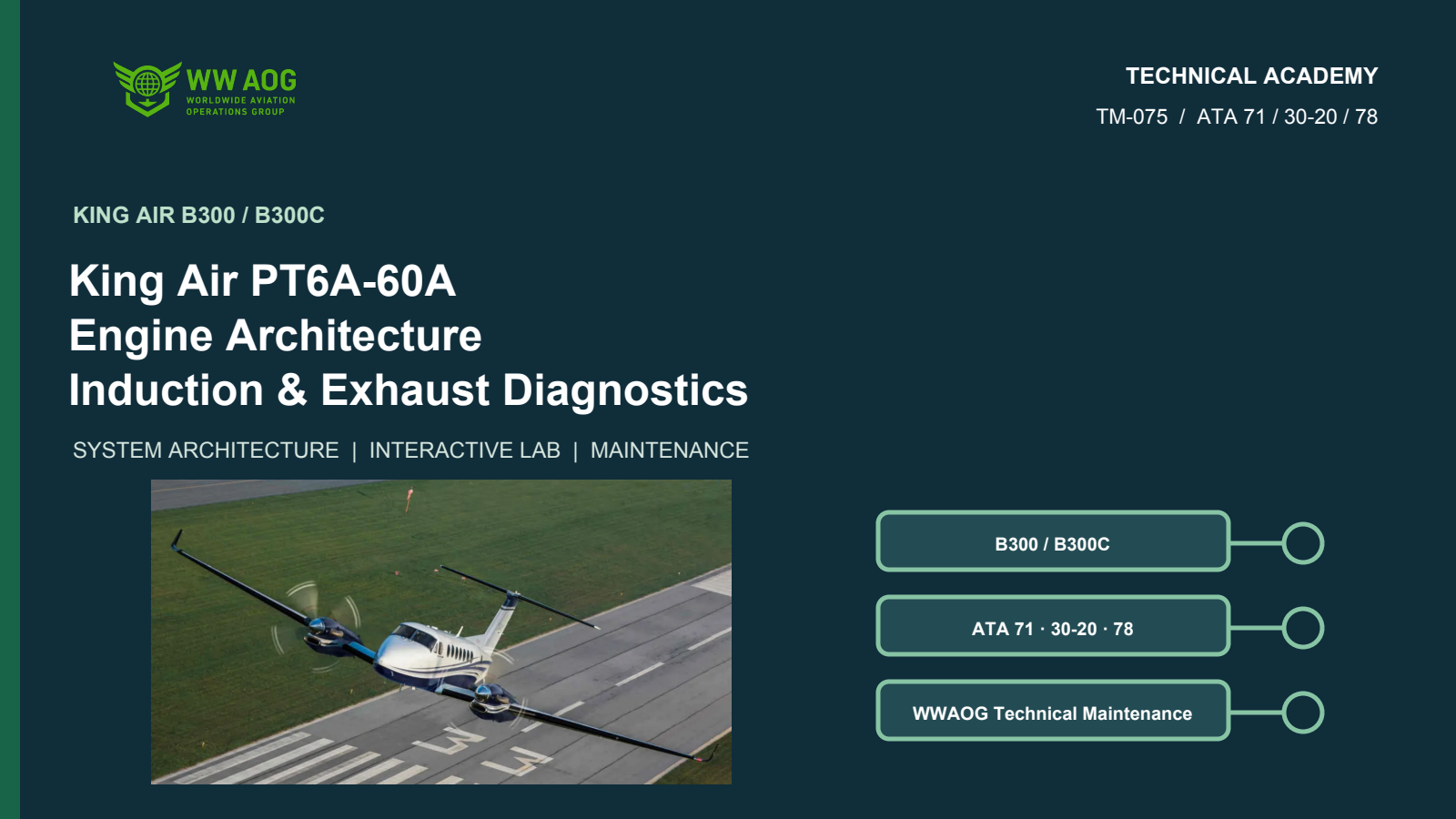
Super King Air B300/B300C with the identified PT6A-60A engine and applicable induction/exhaust equipment. Study the supplied 130-590031-11 Maintenance Manual Chapter 71 and selected Chapter 30 material with effective-page lists dated November 1, 2025, and Chapter 78 with an effective-page list dated November 1, 2024. Individual task dates and configuration applicability remain distinct. Functional engine architecture and airframe interfaces are covered; current aircraft-effective and referenced engine/structural instructions control physical maintenance and repair. Qualitative evidence views do not calculate engine output, heat delivery or automatic transfer timing. Online completion and observed practical qualification are separate.
WWAOG provides independent training. Online completion records knowledge and simulation achievement; it does not replace observed practical qualification, employer authorization or applicable licensing. Use current aircraft-effective maintenance instructions for physical work.