What you will study
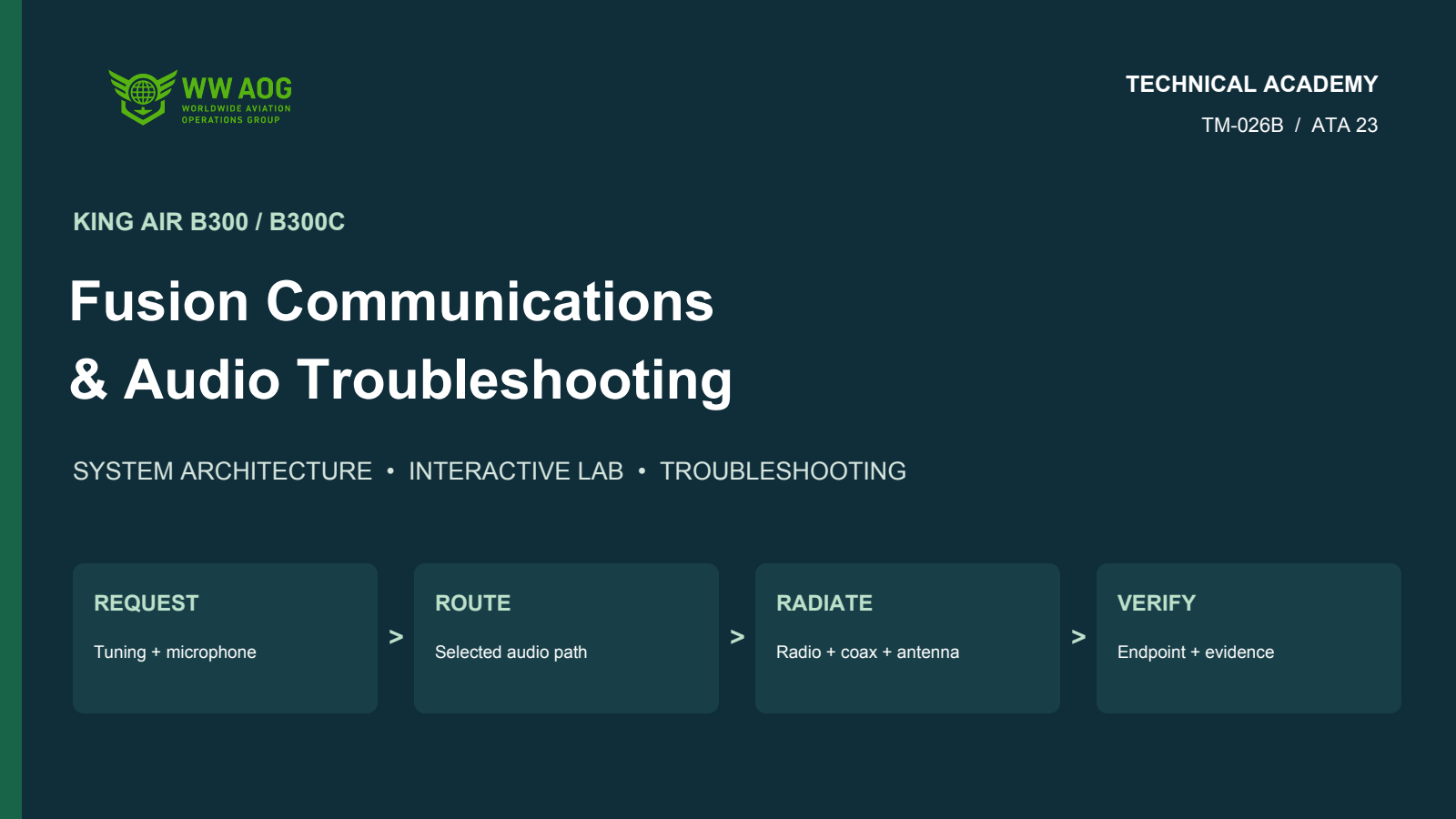
Radio and crew-station paths
Connect tuning and reversionary control to reception, transmission, microphone and PTT evidence. Identify ASPU versus RIU installation differences before selecting the appropriate task.
Audio, RF and recording interfaces
Follow warning audio, speaker inhibit and ground-interphone paths. Compare forward and reflected power, VSWR and path-specific bonding evidence; trace recorder inputs and interruption boundaries.
Practice, evidence and assessment
Eight lessons, six prediction-and-Apply exercises, eight two-stage cases and twelve independent decisions support the separate 40-question final. A referenced 26-page handbook supports the interactive workbench.
Learning outcomes
- Trace voice, tuning and audio-selection paths.
- Separate crew-station symptoms from shared radio or RF faults.
- Interpret path-specific RF and bonding comparisons.
- Record the evidence needed to establish restoration.
Aircraft and course applicability
Factory-Fusion B300/B300C installations described in the supplied chapter, with ASPU versus RIU effectivity distinguished. Optional HF, satellite and data services are identification boundaries, not full maintenance qualifications. Study source: Textron 434-590169-0009, supplied B300/B300C Fusion Chapter 23, pages dated 1 May 2018.
WWAOG provides independent training. Online completion records knowledge and simulation achievement; it does not replace observed practical qualification, employer authorization or applicable licensing. Use current aircraft-effective maintenance instructions for physical work.