WW AOG — Worldwide Aviation Operations GroupView course & enroll ↗
KA200-035 · King Air 200/B200

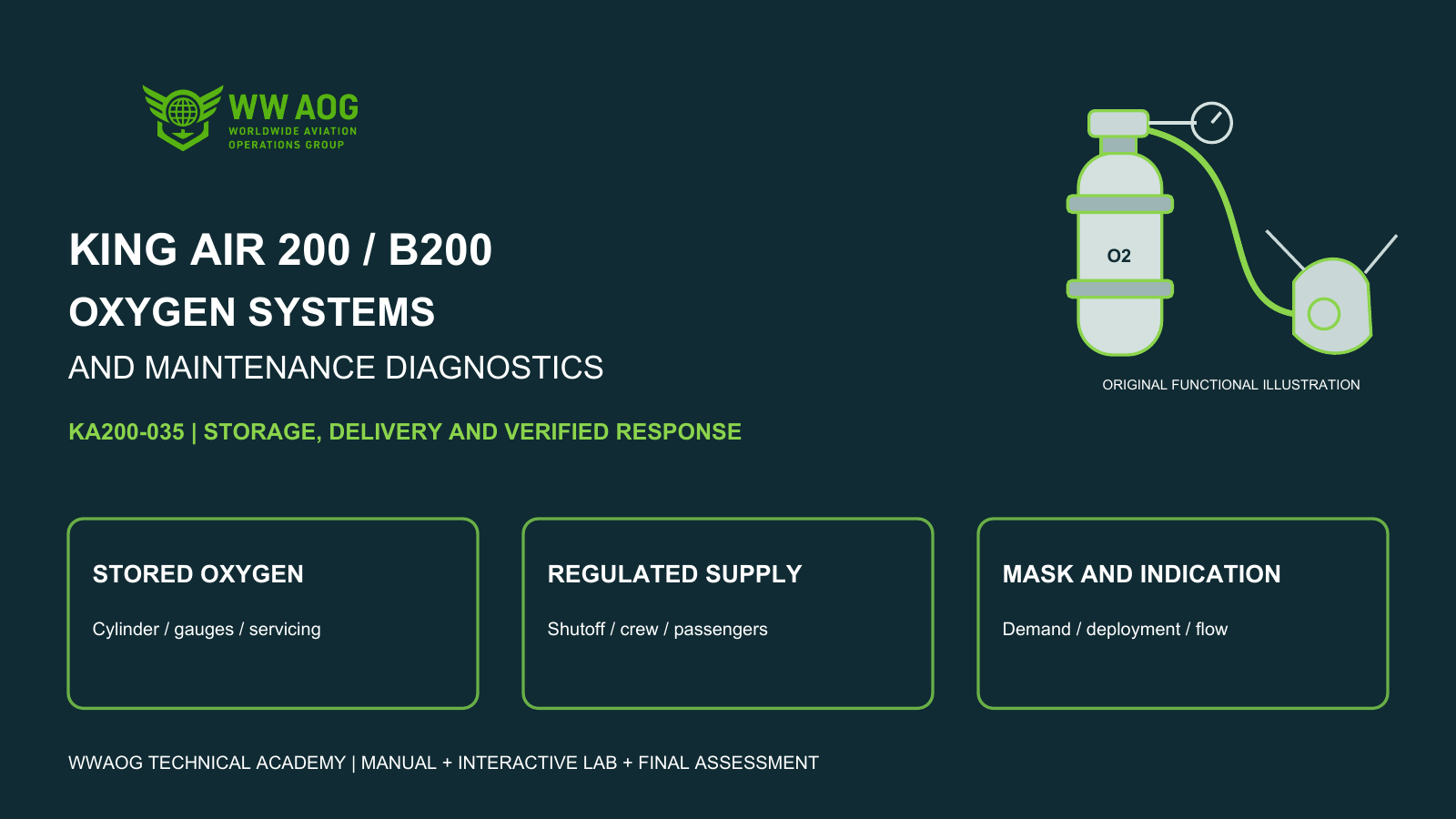
King Air 200/B200 Oxygen Systems and Maintenance Diagnostics

Trace stored oxygen through the cylinder regulator, SYS READY shutoff and separate crew, first-aid and passenger branches. A 40-page handbook, clickable oxygen schematic, eight lesson decisions, ten paired fault cases and two six-field jobs connect pressure, mask deployment, individual flow and maintenance checks. Includes a separate 40-question final at 80%.

Self-paced onlineWWAOG Technical Academy
King Air 200/B200 Oxygen Systems and Maintenance Diagnostics course cover
Inside KA200-035

What you will study

Identify the installed system

Use serial, kits, cylinder/shutoff and mask identification to distinguish manual outlets, autodeployment equipment, early controls and later pedestal controls.

Connect storage, regulation and mask behavior

Trace high-pressure servicing and indication separately from regulated delivery. Explain crew demand functions, first-aid control and the passenger door/lanyard/flow sequence.

Interpret leakage and barometric tests

Select the correct vented/unvented isolation, measure each stabilized connected volume and distinguish installed deployment from isolated switch-continuity criteria.

Restore and demonstrate the repaired function

Use oxygen-compatible materials and equipment, actual mask packing and local leak checks. Build a repeat record for a low-pressure leak and for a pressure-sense repair with the stated special inspection.

Learning outcomes

  • Select the installed oxygen-system and mask task from aircraft and component records.
  • Explain high-pressure storage, regulated delivery and the separate crew, first-aid and passenger paths.
  • Distinguish passenger opening command, door deployment, individual mask flow and pressure-sense annunciation.
  • Interpret stabilized pressure decay and each barometric method under its named conditions.
  • Record correction, restored interfaces and the required repeat tests for an oxygen-system discrepancy.

Aircraft and course applicability

Systems and maintenance-decision training for the identified King Air 200/B200 oxygen installations in supplied Maintenance Manual 101-590010-19 Chapter 35, with its November 1, 2024 effective-page list. Serial, kits, cylinder/shutoff-valve and mask configuration determine the task. The study edition does not establish current aircraft applicability; actual work uses current controlled instructions. Recharge targets and recurring intervals remain in the applicable Chapter 12 and Chapter 05 tasks.

WWAOG provides independent training. Online completion records knowledge and simulation achievement; it does not replace observed practical qualification, employer authorization or applicable licensing. Use current aircraft-effective maintenance instructions for physical work.

Before you enroll

Is this course suitable for my aircraft or role?

Systems and maintenance-decision training for the identified King Air 200/B200 oxygen installations in supplied Maintenance Manual 101-590010-19 Chapter 35, with its November 1, 2024 effective-page list. Serial, kits, cylinder/shutoff-valve and mask configuration determine the task. The study edition does not establish current aircraft applicability; actual work uses current controlled instructions. Recharge targets and recurring intervals remain in the applicable Chapter 12 and Chapter 05 tasks. If you are choosing training for a different installation or a team, email info@wwaog.com with your aircraft configuration, learner experience and training goals.

Where do I find the price and sign up?

Open the KA200-035 enrollment page for the current price, course contents and signup options. Enrollment takes place in WWAOG Academy, where learners access their assigned content.

Can WWAOG train our team at our location?

Yes. Tailored on-site training is available by separate arrangement. Describe your aircraft, location, team size and learning objectives so WWAOG can propose an appropriate scope.

Free course sample · KA200-035

Learn the relationship. Test your reasoning.

Try a short teaching exercise from the subject of King Air 200/B200 Oxygen Systems and Maintenance Diagnostics. No account needed.

About 2 minutes
01 · Understand

On an autodeployment installation, the common passenger oxygen line branches to the container pressure actuator, each individual lanyard valve/mask and pressure-sense switch S209. Oxygen does not pass through the door actuator to reach a mask. A dropped door and PASS OXY ON do not prove flow through every individual mask.

Separate door deployment, pressure indication and individual flow
  1. Common passenger-line pressure
  2. Separate door actuator and S209 pressure branches
  3. Individual lanyard valve controls that mask flow
02 · Read the supplied record

A fictional B200 BB-1800 manual-override check records 70 psi at the specified outlet, passenger doors open and PASS OXY ON illuminated. At one dropped mask the lanyard pin remains inserted; no flow is observed through that individual mask.

03 · Make a decisionWhich component relationship explains this combination of observations?

Original public teaching example based on the course’s published scope. Supplied records and values are training data. Aircraft maintenance uses current applicable instructions; this sample does not record course completion.

Explore more free course samplesReview KA200-035 and enroll ↗

Regional standards and support

Our aircraft systems courses use manufacturer technical manuals to support pilots and maintenance personnel working in FAA- and EASA-regulated aviation. Training combines detailed system explanations, knowledge checks and interactive exercises for initial familiarization and recurrent study.

Training at your location

Your aircraft. Your team. A course built around both.

WWAOG offers tailored on-site courses for operators, maintenance organizations and government teams. We can shape the course around your aircraft configuration, installed systems, technician experience and operational training goals.

Tell us what your team needs

  • Aircraft model and equipment configuration
  • Location, group size and technician experience
  • System topics and desired learning outcomes
  • Preferred dates and available training resources

We’ll agree the scope, delivery plan and quotation before scheduling. Tailored on-site training is arranged separately from individual online course enrollment.

Request tailored on-site training
KA200-035 · Self-paced learning

Build knowledge you can apply to better maintenance decisions.